Sept. 8, 2026 Soft and stretchy or rock solid? New modeling study sheds light on how the Earth got its moon Historically, computer simulations modeling collisions between protoplanetary bodies have treated them largely as fluids. A new study suggests taking into account the material strength of solid bodies drastically changes outcomes.
Aug. 26, 2026 U of A scientists play crucial roles in Nancy Grace Roman Space Telescope science, eagerly await Sunday's launch The launch of the Nancy Grace Roman Space Telescope takes place live Sunday morning at 7:26 am EDT/4:26 am MST on NASA Live.
Aug. 19, 2026 U of A begins building moon-bound EMILIA-3D to study lunar terrain The U of A-led EMILIA-3D is one of three recent science investigation payloads selected through NASA's PRISM SALSA program to study the lunar surface.
April 28, 2026 Drone radar reveals buried glaciers on Earth, guiding the search for water on Mars U of A researchers launched drones equipped with ground-penetrating radar over debris-covered glaciers in Alaska and Wyoming that resemble buried ice deposits found on Mars.
March 17, 2026 Asteroid Bennu's rugged surface baffled NASA. We finally know why In one of the biggest surprises of the OSIRIS-REx mission, its target asteroid, Bennu, turned out to be a jagged, rugged world covered in large boulders.
Jan. 29, 2026 Kissing the sun: U of A researchers unravel mysteries of the solar wind A University of Arizona-led research team has measured the dynamics and ever-changing "shell" of hot gas from where the solar wind originates.
Jan. 28, 2026 U of A takes leading operations role in NASA mission The newly launched Pandora satellite became the first on-orbit NASA mission to be managed from the U of A's Multi-Mission Operation Center, marking a milestone in the U of A's decades-long history in space research and exploration.
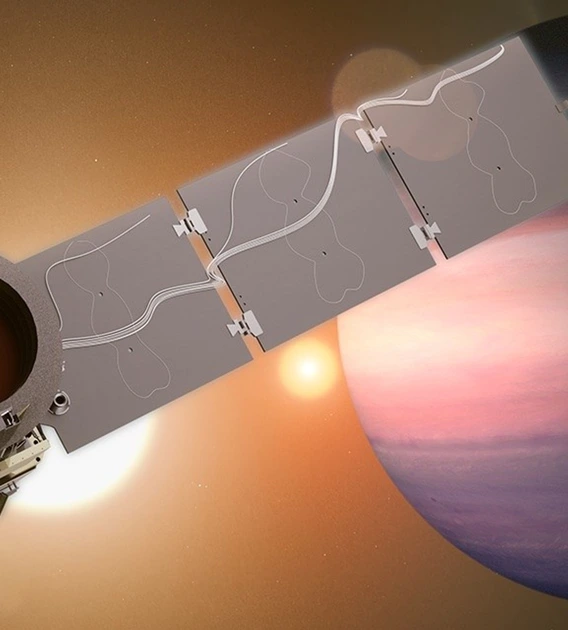
Jan. 9, 2026 Pandora, a keen-eyed satellite built to study exoplanets, takes flight After clearing its last hurdle on its way to space, the University of Arizona-led Pandora satellite mission launched into orbit, where it will study at least 20 exoplanets and their host stars over long periods of time.
Dec. 4, 2025 A new look at TRAPPIST-1e, an Earth-sized, habitable-zone exoplanet Recently reported methane signatures detected by the James Webb Space Telescope could be a hint to it potentially harboring life, but University of Arizona researcher Sukrit Ranjan urges caution.
Nov. 25, 2025 OSIRIS-APEX spacecraft takes selfie with Earth during flyby The spacecraft of the U of A-led OSIRIS-APEX mission performed a "slingshot" maneuver around Earth as part of its journey to catch up with its mission target, asteroid Apophis.